Day 1 Morning: The Guggenheim and the Riverside
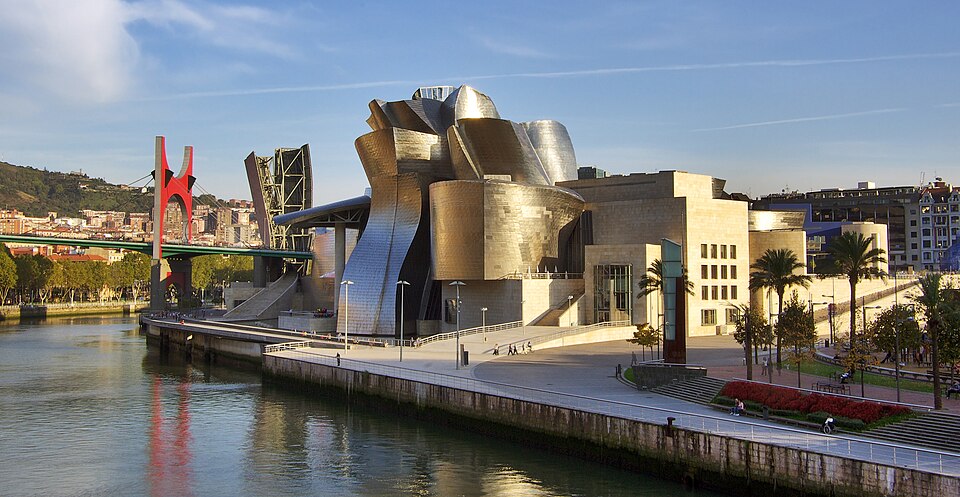
No visit to Bilbao is complete without starting at the Guggenheim Bilbao, Frank Gehry's titanium masterpiece that single-handedly transformed this city's global reputation. Open Tuesday to Sunday from 10:00, tickets cost around €18 for adults — book online a day in advance to avoid queues, especially in summer 2026 when crowds are at their peak.
Allow at least two hours inside for the permanent collection and any temporary exhibitions. Outside, don't miss Puppy, Jeff Koons' giant floral dog, and Maman, Louise Bourgeois' towering spider sculpture — both are free to admire from the riverside promenade.
After the museum, stroll along the Abandoibarra waterfront towards the Zubizuri footbridge, a elegant white arch designed by Santiago Calatrava. The whole stretch is flat, pedestrian-friendly, and offers great views back towards the Guggenheim.
Day 1 Afternoon: Casco Viejo — The Old Quarter
A 20-minute walk or a quick metro hop from Abandoibarra brings you into the Casco Viejo (Old Town), the historic heart of Bilbao. The neighbourhood clusters around Las Siete Calles — literally 'The Seven Streets' — a medieval grid of narrow lanes packed with pintxos bars, independent boutiques, and neighbourhood life.
Key stops include:
- Plaza Nueva: A neoclassical arcaded square that hosts a flea market on Sunday mornings and excellent pintxos bars on every side.
- Catedral de Santiago: A Gothic cathedral dating from the 14th century, free to enter and beautifully restored.
- Mercado de la Ribera: Europe's largest covered market, right on the riverbank — the perfect spot for a coffee and a fresh snack.
- Museo Vasco: A compact and fascinating museum of Basque history and culture, housed in a former Jesuit college. Entry is just €3.
Save your appetite — pintxos hour (known locally as txikiteo) kicks off around 13:00 and again from 19:30. A typical pintxo costs €2–€3, and the rule is simple: order a drink, point at what you want, eat standing at the bar.
Day 2: Bilbao's Hidden Gems and Viewpoints
On your second day, venture beyond the tourist trail. Start with a funicular ride up to Artxanda Hill — the funicular departs from Plaza del Funicular near Casco Viejo and costs just €1.65 each way. At the top, you'll find sweeping panoramic views over the entire city, perfect for morning photos before the haze builds.
Back down in the city, head to the Bilbao Fine Arts Museum (Museo de Bellas Artes), arguably underrated compared to the Guggenheim but containing a superb collection spanning Flemish masters to 20th-century Basque art. Entry is €10, free on Wednesdays.
In the afternoon, explore the neighbourhood of Abando — Bilbao's elegant 19th-century ensanche (expansion district). The wide boulevards around Plaza Moyua are lined with modernist architecture, upscale shops, and the kind of grand cafés where locals read the newspaper over a café con leche. This is very much the real Bilbao away from tourist brochures.
If time allows, the contemporary art space Azkuna Zentroa (formerly Alhóndiga) is worth a look — it's a converted wine warehouse turned cultural centre, with a stunning interior of 43 unique pillars designed by Philippe Starck.
Day Trips and Nearby Towns Worth Considering
Bilbao's location in the Basque Country makes it a natural base for short excursions. If you have time on a Saturday or Sunday morning, these nearby destinations are all reachable within 30 minutes:
- Getxo: A coastal town with beautiful Belle Époque villas, a marina, and the famous Vizcaya Bridge — the world's oldest transporter bridge and a UNESCO World Heritage Site. A must-see for architecture lovers.
- Portugalete: Just across the Nervión estuary from Getxo, this working-class town is connected by the Vizcaya Bridge and has a charming old quarter.
- Mundaka: About 40 minutes by train, this small fishing village is famous for having one of Europe's best left-hand surf waves. Even non-surfers love the scenery.
Getting to these towns from Bilbao city centre is straightforward by metro or local train (Euskotren). If you're travelling with luggage or arriving/departing from Bilbao Airport (BIO), a fixed-price taxi is the most convenient option — see the transport section below for full details.
Getting Around Bilbao: Transport Tips for 2026
Bilbao is a compact, walkable city, but knowing your transport options saves time and avoids confusion — especially around the airport.
Metro and Public Transport
The Bilbao Metro (designed by Norman Foster) is excellent for getting between the city centre, Casco Viejo, and coastal towns like Getxo. However, the metro does not run directly to Bilbao Airport — a common misconception that can catch travellers off guard.
The Bizkaibus A3247 bus connects Plaza Moyua (city centre) to the airport for just €1.70, running every 30 minutes and taking between 30 and 50 minutes depending on traffic. It's the budget option if you're travelling light and not in a hurry.
Taxi from Bilbao Airport
For a stress-free arrival or departure, a fixed-price taxi from Bilbao Airport is by far the most practical choice — no waiting, no meters, no surprises. Taxi Bilbao Aeropuerto offers official licensed drivers, 24-hour availability, and you can book online in under 60 seconds. Payment is made directly to the driver on arrival.
Below are current fixed fares from Bilbao Airport (BIO) to the main surrounding areas:
| Destination | Fixed Price | Approx. Journey Time |
|---|---|---|
| Bilbao City Centre | From €25 | ~20 min |
| Barakaldo | €28 | ~20 min |
| Sestao | €29 | ~21 min |
| Portugalete | €30 | ~22 min |
| Santurtzi | €31 | ~24 min |
| Getxo | €32 | ~25 min |
All fares are fixed regardless of traffic or time of day — making them ideal for early morning or late-night flights.
Bilbao Food Guide: What (and Where) to Eat
Eating well in Bilbao is almost unavoidable. The Basque Country has more Michelin stars per capita than almost anywhere else on Earth, and even the most modest neighbourhood bar takes its food seriously.
Pintxos are the essential Bilbao experience — small bites served on slices of bread, displayed along the bar. The best pintxos streets include Calle del Jardines and Calle Ledesma in Casco Viejo, and Calle Licenciado Poza in the Indautxu neighbourhood.
For a sit-down meal, the area around Plaza Nueva and the Ribera riverbank has excellent mid-range restaurants serving Basque classics: bacalao al pil-pil (salt cod in olive oil sauce), marmitako (tuna and potato stew), and txuleta (aged Basque ribeye steak, often for two).
For coffee and pastries, look out for croissants de mantequilla (buttery croissants) at any traditional café — they're a Bilbao breakfast institution.
Budget tip: A pintxos crawl of 4–5 bars with one drink each typically costs €15–€25 per person and is infinitely more satisfying than a tourist-menu dinner.
→ Book your Bilbao Airport taxi at a fixed price, pay the driver on arrival.